Action. Reaction.
– Chabert
Details
Director: Christophe Barratier
Co-written by Barratier and Phillippe Lopes-Curval
Released March 17, 2004
Nationality French
Budget 5.5 million Euros
Revenue: Worldwide gross of over $83 million
Production Notes
Christophe Barratier wanted to make more things that had some connection to his childhood so looked for a musically driven movie to do this.
The film is an adaption of La Cage aux rossignols.
Barratier had an emotional connection to the film.
Gerard Jugnot and him then collaborated to bring the film to life.
Jean Baptiste Maunier was chosen for his amazing ability to sing and cast him as the “main” singer/actor for the movie.
The other children chosen had very little to no acting experience.
Filming took place at Chateau de Ravel.
Special effects such as fog and practical effects such as scorching walls made the school look more run down and added to its prison like facade.
Synopsis
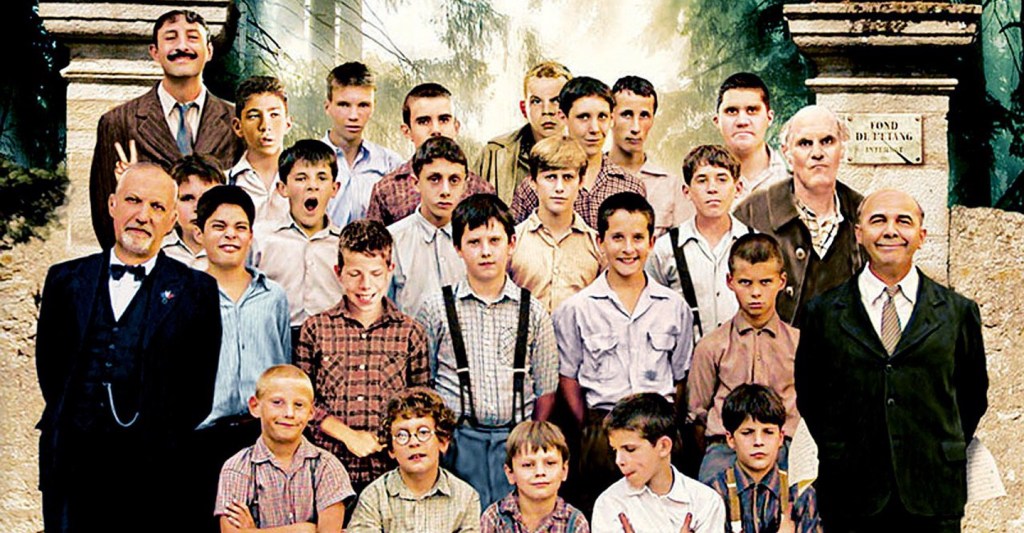
The film begins with a composer, Pierre Morhange, doing his job at a concert and is informed of someone, his mother, passing away. Once home for the funeral a man, Pepinot (Didier Flamand) approaches him and they begin to reminisce about their school days. Pepinot presents him with a book that belonged to their old school prefect, Clement Mathieu (Gerard Jugnot). As they read it they remember exactly what happened through a flashback. Back in 1949 the new prefect, Mathieu, arrives at the school, Fond de l’Étang. There he quickly peruses the dilapidated environments of the school for troubled boys and meets one of the students by the gate of the school, a young Pepinot (Maxence Perrin). The boy says that he was waiting there for his father that said he would pick him up on a Saturday. Unbeknownst to Pepinot his parents were killed in the war, he just hasn’t been informed yet.
He meets the hard headed headmaster of the school, Rachin (Francois Berleand) who he quickly takes a disliking to and vice versa. As the caretaker of the school, Maxence (Jean-Paul Bonnaire) was opening a door the glass on its front shattered, injuring his eye. A prank by one of the students. He also meets the exiting prefect and is warned of the children’s troublesome personalities. Mathieu finds the culprit through his kind and caring attitude toward the children and decides to keep it to himself as the kids were being punished in mean and inhumane ways. He did, however, punish the kid by having him nurse Old Maxence back to health without revealing it was his fault. One day Mathieu discovers the kids singing vulgar songs about him and decides to use that to his advantage. He decides to nurture this aptitude for singing in the kids and in doing so teach them discipline. A perfect teaching plan for someone who used to be a musician and failed at it. Each boy is grouped according to their vocal range. Morhange, the one having the flashback, refused to sing however and mocked him instead. He is punished and sent to solitary confinement.
One day, while Pierre was mopping up the classroom, he spots lyrics on the board and sings them revealing his amazing voice. Mathieu hears this and gives him the part of lead vocalist and a solo. Pierre’s mother (Marie Bunel) arrives to visit, but as he is being punished he cannot be allowed to see her. Mathieu covers for him by telling her that he went to the dentist. Mathieu also develops a crush on the boy’s mother. Afterwards, an even more troubled, psychopath of a boy named Mondain arrives at the school to see how he functions in a group. The boy bullies the weaker kids and thrives on being a nuisance, even standing up to Mathieu and refusing to sing. At one point he steals a watch from one of the teachers and is put in solitary for two weeks straight. As the year goes on everyone is benefitting from the choir. Everyone, including the school, is in a much better state and even the headmaster has begun to play with the kids instead of constantly punishing them. At some point Mondain ends his solitary confinement by escaping and a large amount of school money goes missing. He is, of course, blamed and captured. Rachin slaps and beats him trying to get information out of him but the boy does not budge. He is then sent to the police and Rachin cancels the choir blaming Mathieu for the occurence. Mathieu, however, holds practice in secret in the boys’ sleeping quarters.
During a meeting with Pierre’s mother he tells her how good a singer he is and how he belongs in a conservatory. She also tells him how she has met a rich engineer, breaking his heart without her knowing of his crush on her. Mathieu, ever the kind trooper, fakes enthusiasm for her. After sometime, the school’s Countess is informed of the choir and wishes to see it. Mathieu prepares the boys and puts on the show. During the show, Mathieu gives Pierre back his solo after it was taken away for behaving badly. The Countess loved the show but Rachin took credit for it and the choir. Later on, Mathieu discovers that it was really a boy named Corbin that took the money for the choir and not Mondain. Even with this revelation, Rachin refuses to take him back from the police. During a day of vacation, Mathieu and Maxence take the kids on a hike of sorts and come back to find the school on fire. Mondain came back to get his revenge without anyone knowing. Rachin blames them not being there for the fire.
Even with the knowledge that their actions saved the lives of all the boys that day, Rachin still made the decision to fire Mathieu and suspend Maxence. The boys are refused a goodbye, and as Mathieu leaves he believes no one really cared at the end. Just then papers come flying out the window with farewell messages and the boys sing for their departing teacher. As the men finish the diary, Pierre narrates what happened next for him. He went to conservatory, his mother married the engineer but he later left them when she refused to send him to another boarding school, and Rachin was fired for his inhumane treatment of the boys. Pepinot tells that Mathieu continued teaching music for the rest of his life without ever winning fame. Pepinot then recounts how shortly after Mathieu was fired Pepinot followed him and begged him to take him along. Mathieu refuses but then stops the bus and takes him anyway. Pepinot got a father and the two left the school forever on a Saturday.
Analysis
The Chorus is a heartwarming movie through and through. It is a movie that focuses largely on hope and what it can provide for a person’s life. Throughout the movie the kids are treated like scum because of their circumstances. Most of them were orphans and miscreants without a single person to love them. They were put in the school as a means to help them, but were treated like garbage. It took a fresh, new mind coming in to free them from their lives and this new mind gave the kids hope for the future. This is seen in the lives of Pierre and Pepinot. Mathieu was simply trying to teach them in his own way, but through music he gave these kids a future. Pierre especially benefited from it as he was a hidden talent works in music in the future. This movie emphasizes the effect one normal person can have on a whole society of people. When Mathieu arrived at the school was no better than a prison and its teachers simply wardens, but overtime his presence changed everyone. Mathieu did not achieve many things in his life. He came to the school as a failed musician and left as a failed prefect, but his actions, as small as they seemed to be, left a huge impact.
Society also had an impact on the period of the movie. As the movie was set only a couple of years after World War 2 its effects are still raw in the minds of the characters. Most likely the majority of the kids are orphans because of the war and this is seen keenly in Pepinot’s development. The school also seemed to suffer from the war as France was no doubt still recovering and things like school and other commodities fell to the wayside.
The Chorus is of the Drama genre and at times feels like a musical albeit without the spectacular musical scenes of most. The movie was even adapted into a musical in 2017 by Barratier. A movie similar to it would have to be Dead Poets Society. They are pretty similar in most regards, but most especially in plot. Both have to do with teachers and their unorthodox teaching methods and both end with the teacher’s firing and the boys’ recognition of the teacher’s deeds for them. They were released years apart so I wouldn’t put it past Barratier to have taken inspiration from Dead Poets Society.
Citations
“Les Choristes (2004) – Financial Information.” The Numbers, https://www.the-numbers.com/movie/Choristes-Les#tab=summary.
“The Chorus.” IMDb, IMDb.com, 17 Mar. 2004, https://www.imdb.com/title/tt0372824/.
 Matt's Film Blogs